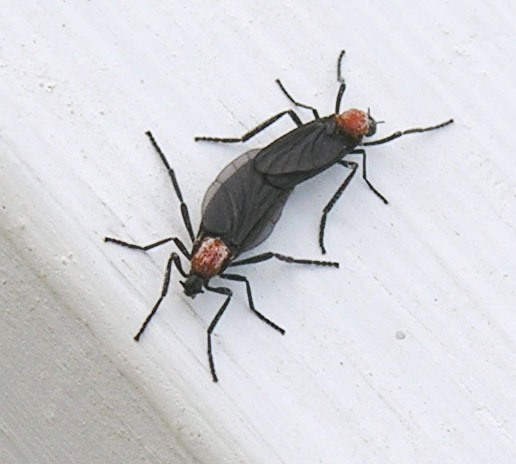
 Hurricane Gustav caused my flight out of Louisiana last week to be canceled 3 times. Finally, I changed my itinerary to fly out of Houston, TX. On the several hour drive there, I met many, many "love bugs" when they plastered themselves on the windshield and grill of my car. During stretches of the drive the bugs were hitting the windshield with such consistency it was as if it was raining. Before dropping the car off in the airport parking lot, I stopped by a gas station to clean the windshield. I was afraid that when I got back the heat might have baked the bugs on the car and made it difficult to clean.
When I drove back to Louisiana 5 days later, the bugs were just as thicker--maybe even more numerous. I drove up to a fast food drive thru and I had to shout my order through a cracked window because when I rolled it down the bugs started flying in the car, so I quickly rolled the windows back up. I considered stopping to clean the windshield rather than waiting until I made it home, but after a long trip I just wanted to get home.
When the bugs splat on the windshield they leave a whitish film. As the bugs add up, it becomes difficult to see. I noticed cars coming in my direction that had windshields that were nearly all white. It looked dangerous!
Eventually, a neighbor explained to me that these were "lovebugs" and she showed me the grill of her car. Lovebugs?!!
According to Wikipedia,
"For most of the year, lovebugs are beneficial in that the larvae (maggots) live in grassy areas and feed on dead vegetation within the thatch[1]. This results in not only the eventual release of nutrients back into the soil, but also decreases excessive thatch which can be detrimental to grass growth and serve as a protective cover for serious grass pests.
The adult lovebug feeds on the nectar of flowering plants. Upon reaching maturity the lovebug spends almost the entirety of its life copulating with its mate, hence its numerous romantic nicknames. The male and female attach themselves at the rear of the abdomen and remain that way at all times, even in flight."It almost makes these insects endearing a la emperor penguins in "March of the Penguins." Until you read on...
In fact, after mating, the male dies and is dragged around by the female until she lays her eggs. . . .
Lovebug flights can number in the hundreds of thousands. . . .
Because airborne lovebugs can exist in enormous numbers near highways, they die en masse on automobile windshields, hoods, and radiator grills when the vehicles travel at high speeds. If left for more than an hour or two, the remains become dried and extremely difficult to remove. In the past, the acidity of the dead adult body, especially the female's egg masses, often resulted in pits and etches in automotive paint and chrome if not quickly removed[3]. However, advances in automotive paints and protective coatings have reduced this threat significantly. Now the greatest concern is excessive clogging of vehicle radiator air passages with the bodies of the adults, with the reduction of the cooling effect on engines, and the obstruction of windshields when the remains of the adults and egg masses are smeared on the glass[1]."
 I wish I'd taken a photo of the windshield but the battery died in my camera. I managed to get this photo before driving the car through the drive wash.
Thankfully, lovebugs aren't not too bad around our town!


No comments:
Post a Comment